
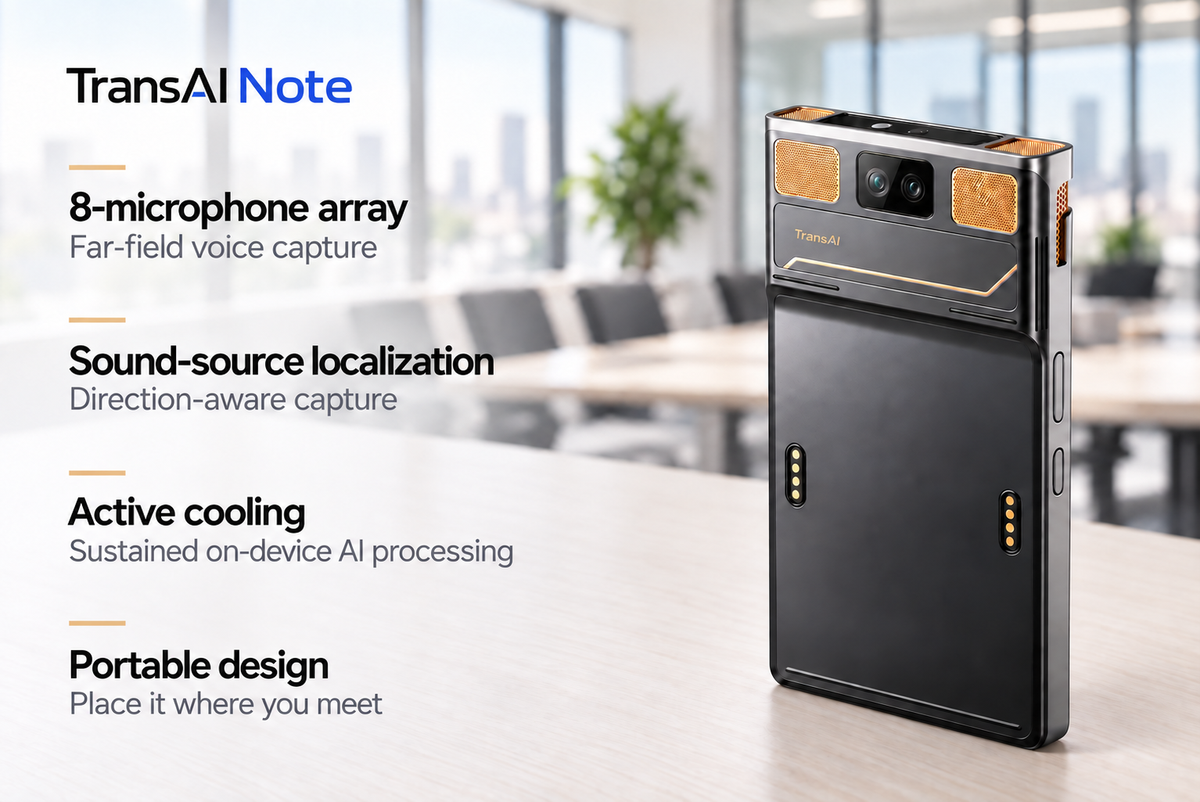
AI meeting notes begin with the conversation a device captures. Microphones and audio processing shape the speech available for transcription. In an on-device AI notetaker, cooling also helps manage the heat of sustained processing, while the physical design determines how easily teams can position the device where they meet.
These choices matter in ordinary meeting moments: a question from the far end of the table, a discussion that runs into a second hour, or a planning session at a customer site. TransAI Note brings an 8-microphone array, sound-source localization, active cooling, and a portable form factor together to support those conditions. Each has a specific job in turning a conversation into notes the team can use.
Why clear audio matters for AI meeting notes
Clear audio gives transcription and summarization a stronger starting point. When an important phrase is missing or difficult to hear, the uncertainty can carry into the meeting record.
Consider a project review. Someone adds a condition to a launch decision: the team can proceed only after a customer confirms a requirement. If that condition is unclear in the recording, a summary may lose an important part of what the team agreed.
That is why capture belongs in any evaluation of an AI meeting notetaker. The relevant question is whether the system can capture the people participating in the discussion, from the positions where they actually speak. A clear recording gives the team a better basis for reviewing the transcript and checking the decisions afterward.
How an 8-microphone array supports room-wide capture
TransAI Note pairs an 8-microphone array with custom far-field processing to capture voices from different positions in the room. The microphones and processing work together as part of the audio capture system.
In a face-to-face meeting, participants are rarely the same distance from the device. One person may be seated nearby, another at the opposite end of the table, and another standing beside a whiteboard. Far-field processing addresses the practical task of capturing speech beyond a close speaking position.
For teams evaluating a device, microphone count is only one part of the picture. Placement, room conditions, and the processing of those microphone signals also matter. A useful demonstration should include people speaking from the seats and standing positions the team normally uses.
The goal is straightforward: give the transcription system usable speech from across the discussion.
What sound-source localization adds
Sound-source localization provides information about where a sound is coming from. TransAI Note uses it to help the capture system account for the direction of speech.
Microphone arrays can support direction estimates by comparing sound received at different microphones. MathWorks’ direction-of-arrival example illustrates this general principle. It is background on the technology, rather than a description of TransAI Note’s specific algorithm.
Direction and identity answer different questions. A direction estimate may indicate that speech comes from the left side of the table. It does not, by itself, establish the speaker’s name. Someone can move from a seat to the whiteboard, and several people can sit in a similar direction from the device.
TransAI Note’s speaker recognition also involves enrolled voiceprints, as described in its capture and transcription process. Keeping these roles clear makes the hardware easier to understand: localization supplies directional information; speaker recognition helps associate speech with a person.
Why active cooling matters for on-device AI
Active cooling helps TransAI Note manage heat during sustained on-device AI processing. Thermal management is part of designing a device that both captures meetings and processes their content locally.
A discussion may continue beyond its planned end. Participants may revisit a decision, add a new constraint, or agree on the next step late in the session. The device’s design needs to account for sustained use as well as the start of a recording.
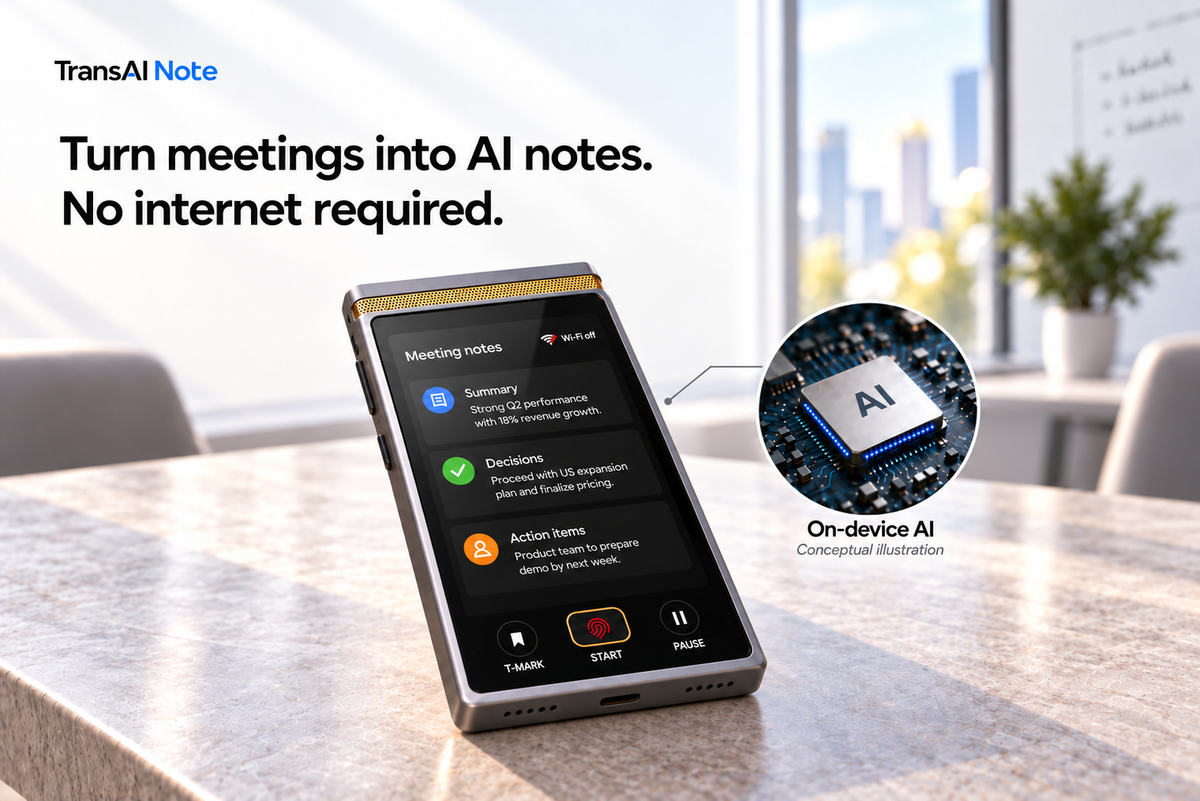
TransAI Note’s core transcription and note-generation functions are designed to operate on the device, including with Wi-Fi off. Active cooling supports that design by addressing heat generated during processing. It should be understood as one part of the system, rather than a promise of unlimited runtime or a guarantee of transcription accuracy.
How portability supports practical placement
A portable form factor lets teams bring TransAI Note to the conversation and position it for the meeting. That may mean a conference table, a workshop, or a customer site.
The value extends beyond carrying the device between locations. Teams can consider where participants will sit, where a presenter will stand, and where the device can remain unobstructed. Those practical choices connect the physical design to the audio capture task.
For a team that meets in several places, an evaluation should reflect that variety. A demonstration in one quiet room cannot answer every question about a different room layout or a more active workshop. Testing the intended setting helps teams judge how the device fits their meetings.
How the four design choices work together
TransAI Note is the private AI notetaker for in-person meetings. Its hardware choices address connected parts of that job:
| Meeting condition | Design choice | Role in the system |
|---|---|---|
| People speak from different positions | 8-microphone array with custom far-field processing | Capture speech across the room |
| Speech comes from different directions | Sound-source localization | Add directional information to capture |
| On-device processing continues during sustained use | Active cooling | Help manage heat |
| Teams meet in different places | Portable form factor | Make transport and placement practical |
Together, these choices provide a foundation for turning conversations into transcripts and structured notes with decisions, owners, and action items. The broader design mission behind TransAI Note connects that captured conversation with the visual context and follow-up work a team needs to preserve.
For anyone evaluating AI meeting notes, the hardware deserves attention alongside the generated summary. Listen to the captured discussion, review the transcript, and check whether the important conditions and next steps remain clear. That is where each design choice meets the practical purpose of the device.


发表评论
所有评论在发布前都会经过审核。
此站点受 hCaptcha 保护,并且 hCaptcha 隐私政策和服务条款适用。