
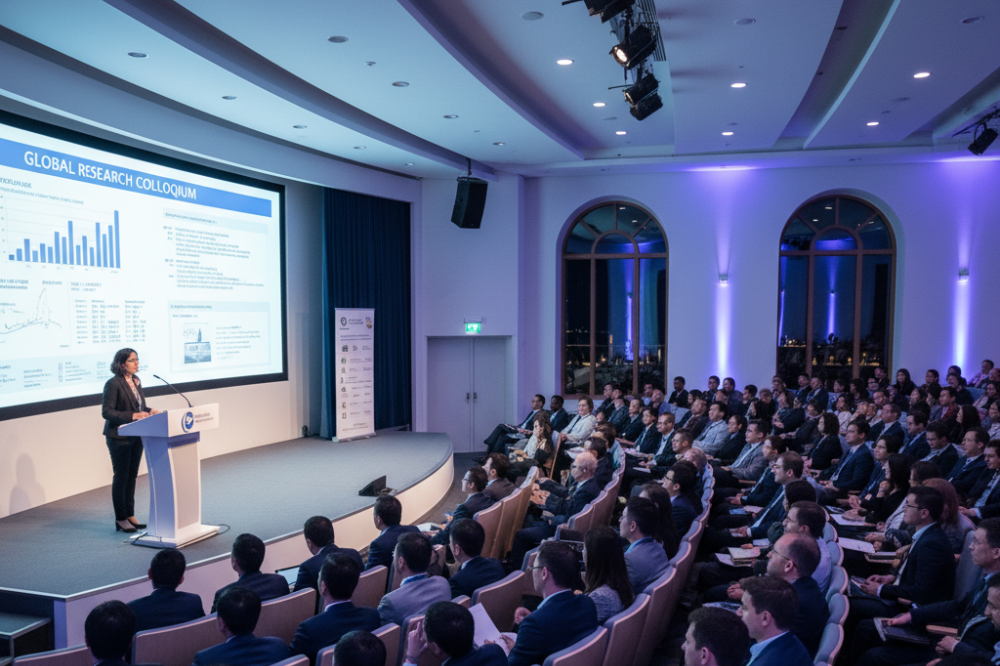
In a world where global research is accelerating every day, cross-border academic communication is more frequent and more crucial than ever. From medicine and artificial intelligence to energy and sustainability, major topics increasingly rely on researchers from different countries and language backgrounds to collaborate and co-create.
Yet, one challenge still stands out clearly—the language barrier.
- Difficulties understanding presentation content
- Inaccurate translation of specialized terminology
- Low-efficiency Q&A sessions
- Limited participation in group discussions
- Barriers during poster sessions and hallway conversations
Many researchers say that even with solid English skills, knowing a language doesn’t mean fully understanding highly technical content. Language uncertainty often turns conferences into exhausting and passive experiences.
The Limitations of Traditional Conference Interpreting
At many large-scale international conferences, organizers may provide professional interpreters, but that usually means:
| Interpreting Method | Advantages | Limitations |
| Professional Simultaneous Interpreters | Highly accurate; reliable | Very expensive (often hundreds of dollars per hour), requires advance booking, limited to main halls |
| Remote Phone / Video Interpreting | No need for onsite setup | Poor interaction experience, not ideal for multi-party real-time discussions |
| Translated PPT or Written Summaries | Helpful reference | Cannot support spontaneous interaction or Q&A |
| Personal English Skills | Flexible | Easily overwhelmed by accents or dense terminology |
The problem is simple: the most valuable part of conferences—real-time communication—is also the hardest to achieve smoothly.
AI Real-Time Translation Is Transforming Academic Conferences
With the rapid development of real-time speech recognition and neural machine translation, more conferences are starting to use AI-powered real-time translation earphones and voice translation systems, enabling:
- Real-time translation for keynote speeches
- Rapid multi-language support in breakout discussions
- On-site collaboration among international research teams
- Poster session communication
- Simultaneous translation for Zoom / Teams / live streaming events
- Smooth cross-border project collaboration phone or video calls
No more forced smiles and nodding when you don’t understand — real-time comprehension brings real participation.
How Real-Time Translation Earphones Improve the Conference Experience
AI translation earphones (like TransAI Genie G1 / GO1) deliver practical advantages:
🧠 Instant Understanding with Minimal Information Loss
No need to wait for delayed subtitles or summary interpretation.
🎤 Real-Time Dialogue for Active Participation
Asking questions and joining debates becomes easier and more natural.
👥 More Efficient Cross-Disciplinary, Cross-Country Collaboration
Communication no longer slows down research progress.
📞 Phone & Video Meeting Translation Support
Modern research depends heavily on remote collaboration:co-authored papers, experiment scheduling, IRB/ethics communication…AI translation tools support real-time translation for phone calls and voice/video apps like WhatsApp or WeChat.
📝 Clear Visual Subtitles
G1 includes LED subtitle display on the charging case, ideal for academic terminology precision.
Why More Researchers Are Adopting AI Translation Solutions
| Key Value | Benefit Gained |
| Conference efficiency | Faster, clearer communication |
| Global collaboration | Lower participation barriers |
| Academic equality | Fair opportunity for non-native speakers |
| Smart cost structure | Reduce professional interpretation expenses |
| Personal research competitiveness | Communicate confidently in real time |
In many international collaborations, communication speed often determines project progress.
AI translation tools let researchers focus on science—not language stress.
Conclusion: Toward a More Open and Efficient Academic Communication Era
As global scientific cooperation accelerates, AI real-time translation is becoming more than a helpful tool—it’s becoming essential infrastructure that supports fair and efficient knowledge exchange.
Solutions like TransAI real-time translation earphones (G1 / GO1) are already empowering professors, researchers, students, and conference organizers worldwide, helping academic communication become more seamless, more direct, and more efficient.
Scientific progress begins with understanding — language should never stand in the way.



留言
所有留言在發布前都會經過審核。
此網站已受到 hCaptcha 保護,且適用 hCaptcha 隱私政策以及服務條款。